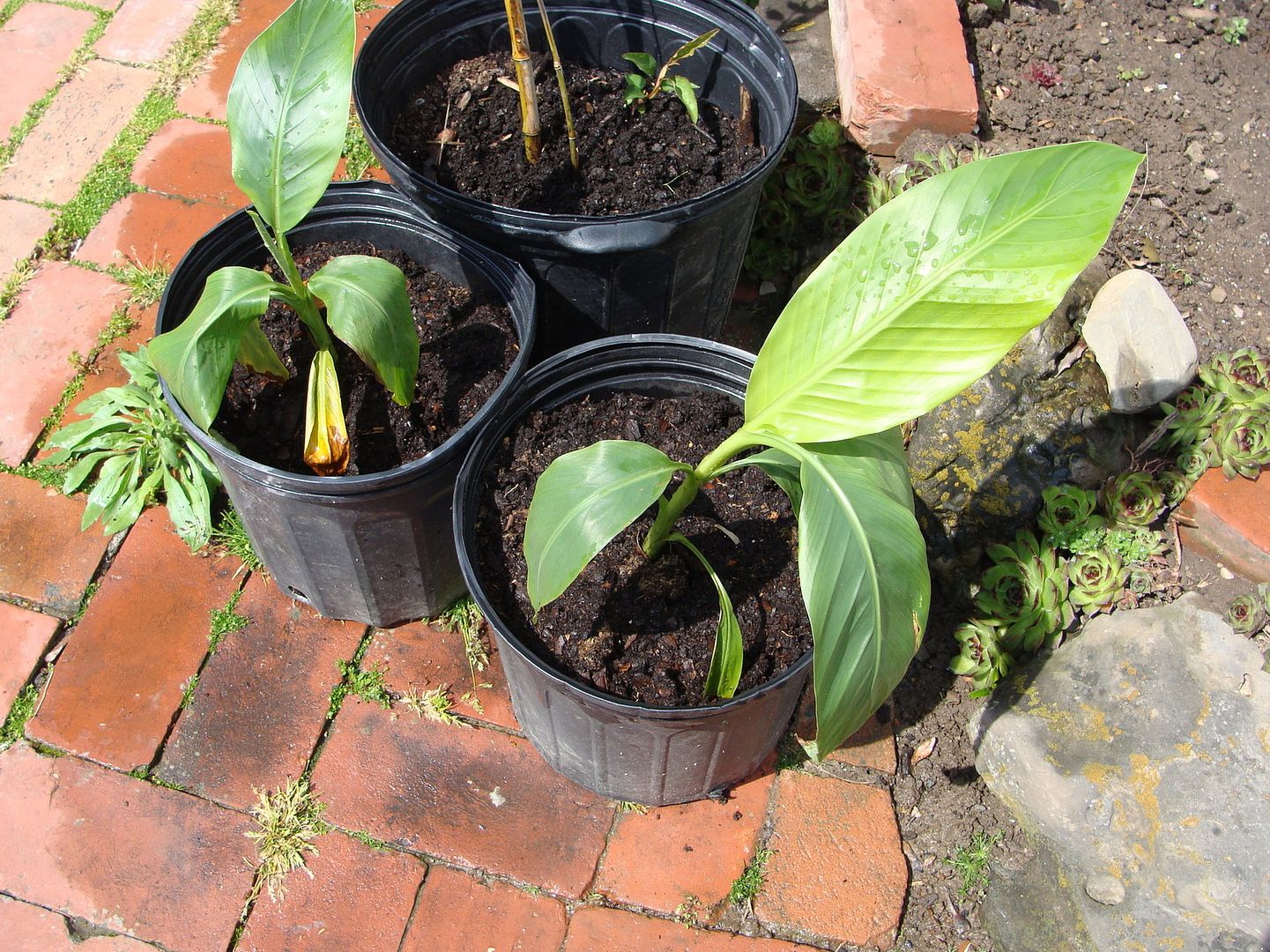
I tried purchasing musa mekong giant last year however they never made it through the winter when I tried planting them outside. The appeared to still be alive by the spring time however too much moisture in the spring must have killed them out so I ended up ordering a couple more of them from eBay this spring. Here's the links to when I tried them last fall.
http://stevespeonygarden.blogspot.com/2011/10/new-banana-plants-musa-mekong-giant.html
http://stevespeonygarden.blogspot.com/2011/10/fall-update-on-banana-plants-2.html
I bought them as tiny plants in 2 inch pots some time in April of this year to replace the ones I lost last fall.
3 May 2012
Plant 1 on the right, and plant 2 on the left.
Search This Blog
Showing posts with label rhizomes. Show all posts
Thursday, October 11, 2012
Progress of the musa mekong giant "itinerans"
Labels:
botany,
cold hardy banana plant,
foliage,
greenery,
growth progress,
huge leaves,
musa itinerans,
nature,
new leaf,
over time,
overwintering,
planting,
rhizomes,
running banana,
time lapse,
tropical northern climate
Thursday, July 5, 2012
Moso Bicolor growth diary starting from 18 March 2011
18 March 2011; Here's how it looked with 2 tiny, but bushy culms when I got it, and planted it into a 15 gallon container.
Labels:
beautiful,
dense foliage,
division,
documentation,
golden culms,
growing boo,
growth over time,
healthy,
juvenile,
leaf drop,
ornamental rare bamboo,
overwintering,
planting,
rhizomes,
tarps,
variagated,
yellowing
Tuesday, May 15, 2012
Air layering running bamboo shoots for small divisions
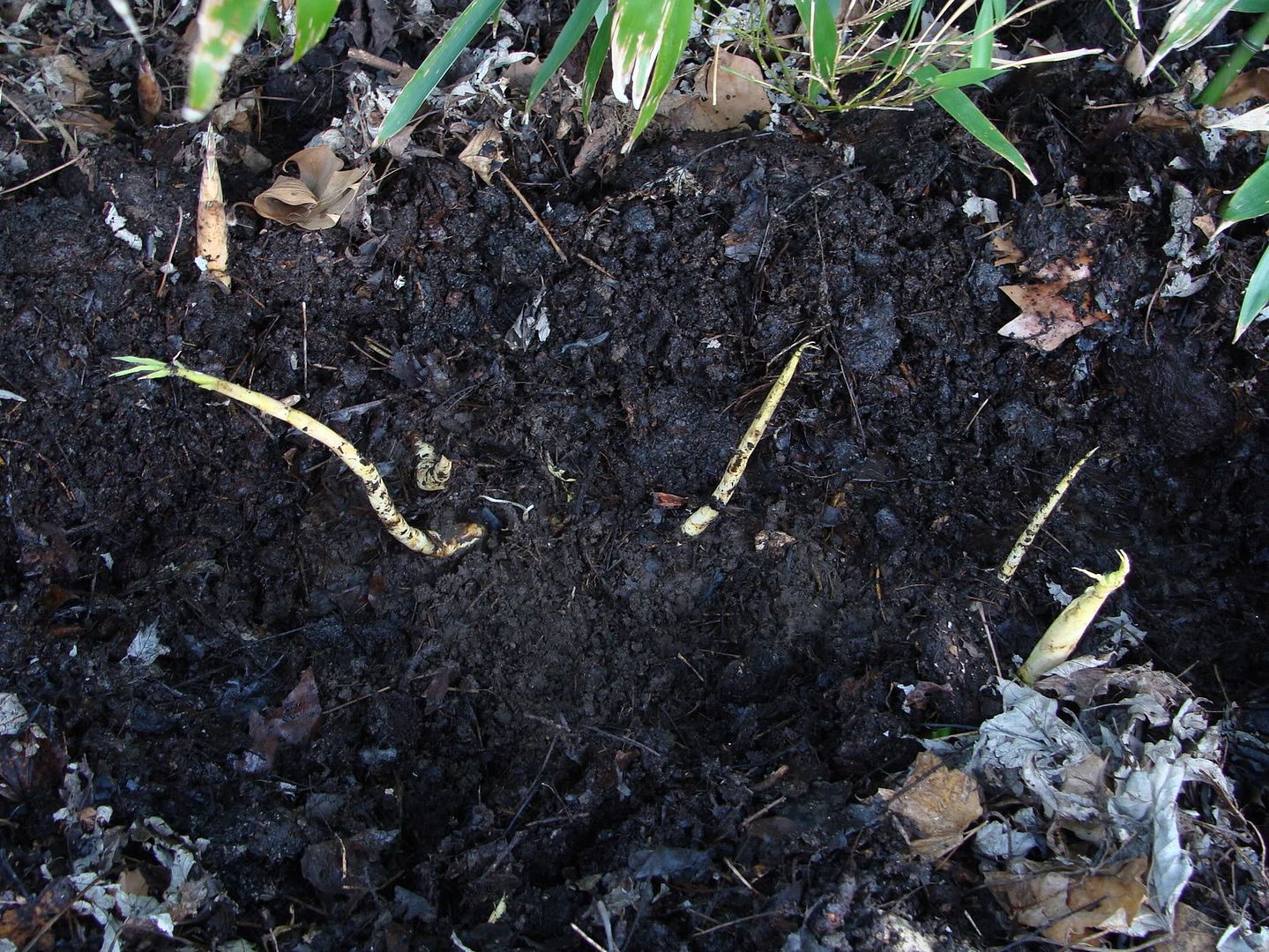
Last year, I did an experiment where I took a phyllostachys dulcis shoot that hasn't formed its anchor roots yet, and forced it through the drainage hole of a nursery pot, filling it up with soil. As expected, it turned out to be a viable division as 4 rhizomes grew out of the based of that shoot after it was severed from the mother plant.
The biggest problem was that the shoot that emerged was too big, and had too many anchor roots that dried up it's little 2 gallon put very quickly. Last year I grew a rhizome close to the surface on purpose in order to promote the formation of smaller shoots which are easier to work with, and I can get plenty of which will be less of a burden for the mother plant since they are so small. As expected, the mini-shoots formed. This propagation method can be used for running bamboos that have a hard time running, or juvenile bamboos where you want to turn small shoots into divisions without draining the energy of the mother plant too much. These are clearly true shoots because you don't always have whip shoots available in the spring.
I'll guess I can name this shoot bud activation, air layering propagation.
Here's the shoots that were downsized while the shoots on both ends of the same rhizome are full size.
The biggest problem was that the shoot that emerged was too big, and had too many anchor roots that dried up it's little 2 gallon put very quickly. Last year I grew a rhizome close to the surface on purpose in order to promote the formation of smaller shoots which are easier to work with, and I can get plenty of which will be less of a burden for the mother plant since they are so small. As expected, the mini-shoots formed. This propagation method can be used for running bamboos that have a hard time running, or juvenile bamboos where you want to turn small shoots into divisions without draining the energy of the mother plant too much. These are clearly true shoots because you don't always have whip shoots available in the spring.
I'll guess I can name this shoot bud activation, air layering propagation.
Here's the shoots that were downsized while the shoots on both ends of the same rhizome are full size.
Labels:
air layer,
anchor roots,
bamboo division,
cloning,
culm,
dividing,
dwarfing,
leaves,
little,
mini micropropagation,
rhizomes,
rooting gel,
sheaths,
shoot buds,
small,
splitting,
spreading,
tiny boo,
viability
Saturday, May 5, 2012
Bamboo removal made easy
Since bamboos are one of the plants I collect, I did have collected many types and I have also gotten rid of many types of bamboo as well. There are basically 2 ways to get rid of bamboo. 1)Cut all the culms down to the ground with a lopper or chainsaw and keep repeating until the grove runs out of energy or shoot buds. 2) Dig it all out, and check for missed pieces.
The reason why I am writing this blog is because sometimes people have problems with certain types of bamboos. Some species of bamboo can become invasive if they are grown in the right climate/ conditions or if the owner of the property doesn't understand or care about it. A lot of people don't know how to properly control, or get rid of bamboo which can cause problems for neighbors. If you have an understanding of how bamboos grow, it can actually be very easy to get rid of.
Method 1:
This method only requires a lopper and maybe a lawnmower if feasible. Most loppers cut up to 2 inches in diameter, but if the culms are bigger, an electric chainsaw will be sufficient. This method is preferable if the bamboo you want to remove covers a lot of ground ie several acres.
1. First It is best to wait until spring when new shoots start rising and get to 2-6 feet tall. This means that many buds have activated, and the bamboo is expending its energy.
2. When the new shoots are several feet tall, it is now time to cut down all over the existing culms to soil level in order to remove all of the plant's source of photosynthesis, but the new shoots should be left alone to continue draining the energy from the grove.
3. Once the new shoots reach their full height and they are branched out, but before they start leafing out, it is time to cut all these new shoots down to soil level when the energy of the grove is almost completely depleted.
4. With the remaining energy left in the grove, the bamboo may still have the ability to generate very small survival culms. The best thing is to wait for them to finish their growth and repeat the process over by cutting them to soil level right before leaves are about to form. Regrowth can happen 3-4 times, but the size and number of them should decrease each time as the number of viable shoot buds are reduced, and the energy dwindles. If it is an open area, planting grass seeds, and keeping the area mowed will be sufficient.
The idea is to starve the bamboo of all its starches stored in the rhizome system and herbicides are generally ineffective.There is no need to remove the rhizomes as they will die and rot away without a source of energy for several months, and there is no need to pay thousands of dollars to remove bamboo with heavy machinery when you can do it by yourself with simple tools such as loppers and chainsaws.
Method 2:
This method is only feasible when there's is not that much bamboo, and it can all be dug up in a few hours, and the benefit is that the bamboo can be removed all on the same day as long as every rhizome is taken out.
1. The first step is to wait until after a nice rain when the soil is easy to dig through.
2. Cut all the culms down to soil level so they are out of the way.
3. Dig out every piece of rhizome starting from the perimeter inwards. Most bamboos only grow near the top of the soil. This can be done with a sharp shovel, a pick and loppers. The inside of the grove is harder to dig out as some species can form a solid root mass if culms were growing very closely.
4. Wait about a month and check to see if there are any sprouts. It's very possible to miss a few pieces which can easily be detected when they start shooting.
Here are a few pictures to show some results on some of the bamboos that I have removed.
Phyllostachys Aureosulcata (yellow groove)
Before:
The reason why I am writing this blog is because sometimes people have problems with certain types of bamboos. Some species of bamboo can become invasive if they are grown in the right climate/ conditions or if the owner of the property doesn't understand or care about it. A lot of people don't know how to properly control, or get rid of bamboo which can cause problems for neighbors. If you have an understanding of how bamboos grow, it can actually be very easy to get rid of.
Method 1:
This method only requires a lopper and maybe a lawnmower if feasible. Most loppers cut up to 2 inches in diameter, but if the culms are bigger, an electric chainsaw will be sufficient. This method is preferable if the bamboo you want to remove covers a lot of ground ie several acres.
1. First It is best to wait until spring when new shoots start rising and get to 2-6 feet tall. This means that many buds have activated, and the bamboo is expending its energy.
2. When the new shoots are several feet tall, it is now time to cut down all over the existing culms to soil level in order to remove all of the plant's source of photosynthesis, but the new shoots should be left alone to continue draining the energy from the grove.
3. Once the new shoots reach their full height and they are branched out, but before they start leafing out, it is time to cut all these new shoots down to soil level when the energy of the grove is almost completely depleted.
4. With the remaining energy left in the grove, the bamboo may still have the ability to generate very small survival culms. The best thing is to wait for them to finish their growth and repeat the process over by cutting them to soil level right before leaves are about to form. Regrowth can happen 3-4 times, but the size and number of them should decrease each time as the number of viable shoot buds are reduced, and the energy dwindles. If it is an open area, planting grass seeds, and keeping the area mowed will be sufficient.
The idea is to starve the bamboo of all its starches stored in the rhizome system and herbicides are generally ineffective.There is no need to remove the rhizomes as they will die and rot away without a source of energy for several months, and there is no need to pay thousands of dollars to remove bamboo with heavy machinery when you can do it by yourself with simple tools such as loppers and chainsaws.
Method 2:
This method is only feasible when there's is not that much bamboo, and it can all be dug up in a few hours, and the benefit is that the bamboo can be removed all on the same day as long as every rhizome is taken out.
1. The first step is to wait until after a nice rain when the soil is easy to dig through.
2. Cut all the culms down to soil level so they are out of the way.
3. Dig out every piece of rhizome starting from the perimeter inwards. Most bamboos only grow near the top of the soil. This can be done with a sharp shovel, a pick and loppers. The inside of the grove is harder to dig out as some species can form a solid root mass if culms were growing very closely.
4. Wait about a month and check to see if there are any sprouts. It's very possible to miss a few pieces which can easily be detected when they start shooting.
Here are a few pictures to show some results on some of the bamboos that I have removed.
Phyllostachys Aureosulcata (yellow groove)
Before:
Subscribe to:
Posts (Atom)